
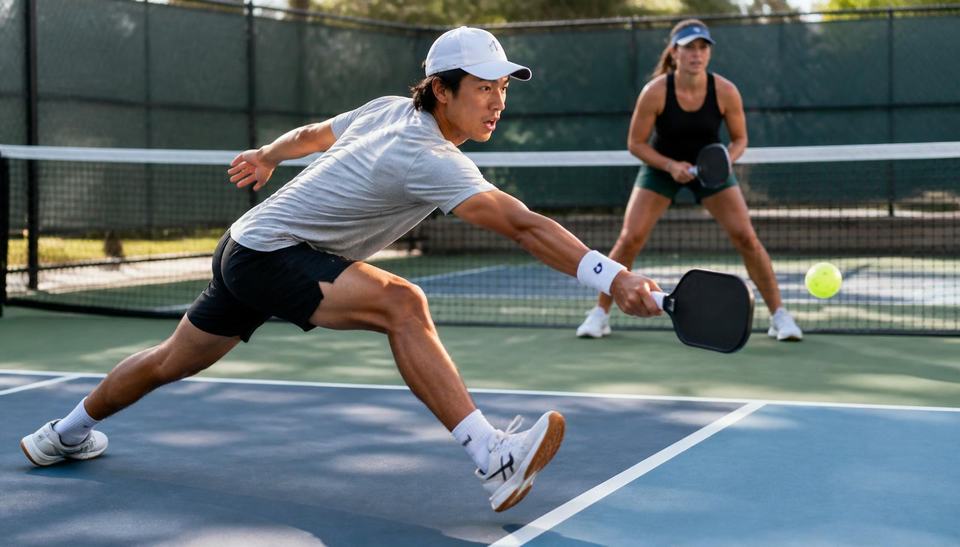
5 weeks · 3x / week · Active Adults
Pickleball Split-Step Power
Five weeks on the one movement that decides every kitchen exchange: a fast, low, reactive split step and the push that follows it.
How to run it
- The split step is a landing, not a hop. Land loaded, land quiet, and be ready to push in either direction.
- Sessions are 25 to 35 minutes. This is a power block; if it becomes conditioning, it stops working.
- Every reactive drill responds to a partner or a ball, never to your own count.
Springbak® note
Every split step is a landing on a hard court. Install Springsoles according to each court shoe’s liner type in week 1 and keep them for the whole block, including the week 5 retest.
Shop SpringsolesThe goal
Cut reaction-to-first-contact time by one full step on a partner-fed dink exchange.
How it progresses
Phase 1 · Weeks 1-2
Split-step timing and low-position strength, unhurried.
Phase 2 · Weeks 3-4
Reactive split steps into first-step pushes at game speed.
Phase 3 · Week 5
Live dink exchanges, then retest.
What you test
- Split-step reaction
- Partner points left or right at random; count the steps needed to reach a cone 8 feet away.
- Lateral bound distance
- Best of three per side, stuck landings only.
- Sit-to-stand in 30s
- Reps in 30 seconds. A simple, repeatable measure of leg power.
What you need
- Court access
- Paddle and balls
- Cones
- Partner
The week
Day 1
Position and strength
Split-step to stick
Quiet landing, knees soft
4 x 6
Lateral step-down
3 x 8 per leg
Goblet squat
3 x 10
Single-leg balance holds
3 x 30s per leg
Day 2
Reactive power
Partner-cue split step
10 reps
Lateral bound to stick
4 x 4 per side
8-foot shuffle-and-reach
8 reps per side
Pogo hops
3 x 10
Day 3
On-court transfer
Live dink exchange
5 rounds x 90s
Kitchen-line reset drill
8 reps
Calf raises
3 x 15
Short-foot holds
3 x 30s per foot
Questions about this block
I'm 65 — is this appropriate?
Yes. Use the Active Adults prescriptions, take a full day between sessions, and start bounds at half distance.
Indoor or outdoor court?
Either, but test on the same one every time — surface grip changes reaction numbers more than training does.
Related programs
6 weeks · 3x / week
Pickleball Court Fitness
4 weeks · 3x / week
First-Step Quickness
6 weeks · 4x / week
Foot & Ankle Resilience
Footwear for this block: Pickleball insoles
Run this next
Build your next block
Tell us your sport, the number you want to move next, and the date of your first competition. We re-rank the program library against those answers and show you why each block placed where it did.
Off-season · Nothing to protect on the weekend, so this is where the heavy, high-volume blocks belong.
Best match · 5 weeks · 3x / week
Change of Direction
Cut harder and re-accelerate sooner — a faster pro-agility and a cleaner plant under fatigue.
Why this fits · We ranked this here because it was written for Pickleball.
- Written for Pickleball
Option 2 · 4 weeks · 3x / week
First-Step Quickness
Beat your defender off the first two steps — measured by a faster 5-yard and 5-10-5 shuttle.
Why this fits · We ranked this here because it was written for Pickleball.
- Written for Pickleball
Option 3 · 12 weeks · 2x / week
In-Season Maintenance (Two Days)
Finish the season within 5 percent of your preseason vertical jump and broad jump.
Why this fits · We ranked this here because it carries over to any sport and off-season work is exactly what belongs in off-season.
- Works for every sport
- Fits off-season